
7 Ways AI Chatbots Reduce Customer Service Costs
Ananya Desai
Head of AI Research
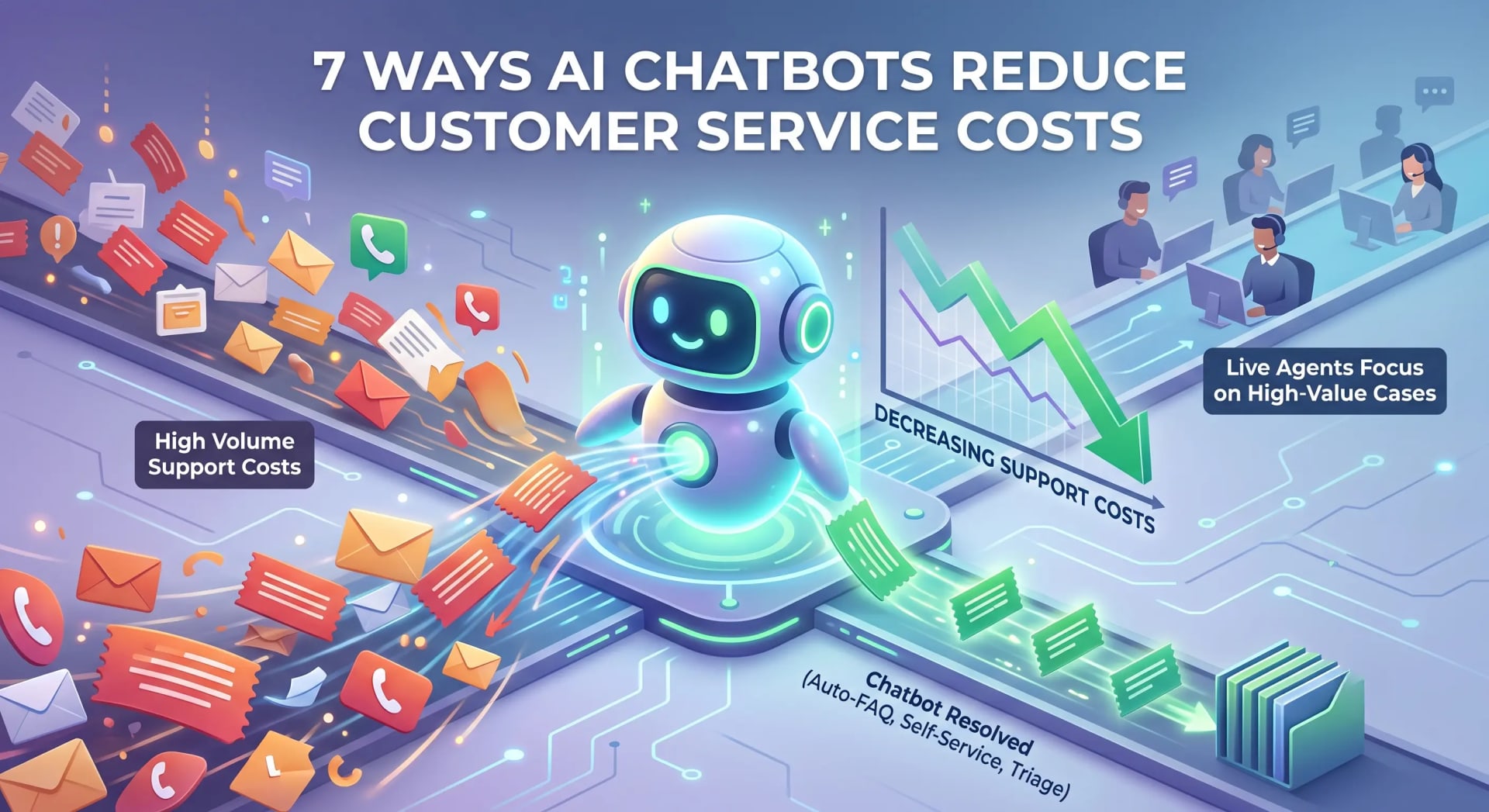
AI chatbots reduce customer service costs by 30–50%, handling routine inquiries for $0.50–$0.70 per interaction compared to $15–$60 for a human agent — a 95% reduction per interaction. Beyond the cost savings, they cut response times, free up agents for complex work, and scale without adding headcount.
Here's what that looks like in practice across 7 areas:
- Automating repetitive inquiries — chatbots resolve up to 80% of common questions like "Where's my order?" or "What's your return policy?"
- Providing 24/7 support — round-the-clock coverage at a fixed rate, no overtime
- Reducing handling time — faster responses, fewer escalations, lower labor cost
- Lowering hiring and training expenses — routine tasks handled by AI, smaller teams needed
- Managing seasonal peaks — surges absorbed without temporary staff
- Improving self-service — consistent support across websites, apps, and social media
- Using data insights — continuous workflow optimization that compounds savings over time
AI chatbots are scalable, cost-effective, and improve customer satisfaction while cutting operational expenses. Companies using them report millions in annual savings. Klarna's AI assistant (ChatSpark) handled 2.3 million conversations in a single year — work equivalent to 700 full-time agents — saving an estimated $40 million.
1. Automating High-Volume Repetitive Inquiries
A large share of customer support tickets comes down to the same questions asked repeatedly: "Where is my order?" "What's your return policy?" "Are you open on weekends?" These repetitive inquiries consume a disproportionate amount of your support team's time while requiring almost no judgment to answer.
AI chatbots act as first-line responders, handling these routine questions instantly. They resolve up to 80% of common inquiries, leaving your team to focus on issues that genuinely need a human.
Cost Reduction Impact
Human agents spend roughly 20% of their time answering routine questions. AI chatbots take over that workload and respond in milliseconds, eliminating the labor cost tied to those interactions entirely.
Camping World introduced a virtual assistant named Arvee that increased customer engagement by 40% across all platforms and cut wait times to 33% of previous levels. For businesses handling thousands of tickets monthly, that kind of automation produces real dollar savings — not just efficiency improvements on paper.
Operational Efficiency Improvements
Automation also changes how the rest of the queue moves. Companies using AI chatbots report a 37% reduction in first response times and a 52% improvement in ticket resolution speeds.
AI chatbots improve efficiency further by automating the triage process — gathering initial customer information, identifying intent, and routing complex cases to the right agent. Your team spends less time on "Where's my package?" and more time on issues that need their expertise.
Suitor, an Australian formal wear rental company, automated 85% of customer service inquiries with AI chatbots. Gecko Hospitality, a recruitment firm, automated 90% of routine customer service requests. Both scaled their support operations without increasing headcount.
Benefits of AI Chatbots
There are 5 core operational benefits AI chatbots deliver for support cost reduction:
- No salary or benefits — chatbots operate around the clock at a fixed platform cost
- Instant, consistent responses — no wait times for order status checks, password resets, or FAQs
- Knowledge base integration — responses pull directly from your documentation, staying accurate automatically
- Unlimited scaling — handles inquiry surges without adding staff
- Continuous learning — the system improves routing and accuracy with every interaction
Chatbot Limitations
Chatbots handle structured, predictable questions well. Complex issues requiring human judgment, empathy, or nuanced decision-making still need a live agent. Varied phrasing can also cause recognition failures — if the bot doesn't understand how a question is worded, it may frustrate the customer and force an escalation.
The solution is training, not replacement. A well-maintained chatbot handles what it handles well and escalates cleanly when it can't.
Comparison Table: Chatbots vs Live Agents
| Factor | AI Chatbots | Live Agents |
|---|---|---|
| Cost per Interaction | $0.50–$0.70 | $15–$60 |
| Availability | 24/7 | Business hours + overtime |
| Response Time | Milliseconds | Minutes to hours |
| Simultaneous Conversations | Unlimited | One at a time |
| Complex Problem Solving | Limited to trained scenarios | Full range |
| Emotional Support | Standardized responses | Empathy and personalization |
| Training and Maintenance | Lower, one-time setup | Ongoing |
Success Stories in Healthcare
Healthcare shows some of the clearest results from automating repetitive inquiries:
- Northwell Health reduced call center traffic by 50% by automating appointment scheduling and basic patient inquiries
- Premera Blue Cross introduced a chatbot helping members compare procedure costs at different facilities, cutting support calls
- Mayo Clinic built a surgical journey bot addressing pre- and post-operative questions, reducing workload for medical staff
Tips for Effective Implementation
- Prioritize high-volume questions — AI chatbots handle up to 80% of support tickets. Start by identifying your top 10 most common inquiry types and automate those first.
- Maintain accuracy and build trust — review automated responses regularly. A midsize airline achieved an 80% containment rate and 90% accuracy managing 1,200 weekly interactions by continuously auditing bot outputs.
- Track key metrics — monitor resolution rate, containment rate, and escalation frequency from day one.
Best Questions to Automate
| Query Type | Automation Benefit |
|---|---|
| New customer queries | Fast answers that demonstrate product value immediately |
| Shipping policies | Consistent, always-current communication |
| Product questions | Instant information and comparisons that increase purchase likelihood |
| Order status | Real-time lookup from your e-commerce platform, no agent involved |
| Return and refund policy | Clear, repeatable answers that reduce follow-up contact |
2. Providing 24/7 Support Without Overtime Costs
Customer inquiries don't stop when the workday ends. Relying on human agents for late-night, weekend, or holiday shifts drives costs up fast — overtime pay and night shift premiums typically add 10–20% to base salaries. AI chatbots deliver round-the-clock support at a fixed platform cost, eliminating those variables entirely.
Cost Reduction Impact
The numbers are difficult to ignore. Klarna's AI assistant handled 2.3 million conversations in 2024 — work that would have required 700 full-time agents — and saved the company an estimated $40 million by cutting resolution times from 11 minutes to under 2 minutes. Vodafone's TOBi chatbot autonomously resolved 70% of customer inquiries, cutting per-chat costs to less than a third of traditional live chat.
Labor expenses account for up to 95% of a contact center's total costs. By automating after-hours support, businesses directly address their largest single expense. Conversational AI (AI) is projected to save companies $80 billion in contact center labor costs by 2026.
Each chatbot interaction saves $0.50–$0.70 compared to a human-handled query. At scale, that difference funds meaningful growth.
Scalability for U.S. Businesses
AI chatbots handle multiple conversations simultaneously — no additional staff required. During peak seasons, Alibaba's AI chatbots handle over 2 million sessions daily, saving approximately $150 million annually in customer service costs.
These systems also provide instant support across time zones, removing the need for overseas call centers or multi-shift staffing. With support for over 85 languages, they eliminate the need for specialized night-shift coverage entirely.
Operational Efficiency Improvements
24/7 AI support improves service quality alongside cost reduction. American Express, after introducing AI chatbots in May 2025, achieved a 90% faster response time and a 22% increase in customer satisfaction. Unlike human agents who may struggle with fatigue during late-night shifts, AI chatbots maintain consistent accuracy and tone regardless of hour.
Cost Comparison Analysis
| Support Type | Traditional 24/7 Team | AI Chatbot Solution |
|---|---|---|
| Monthly Cost | $11,619 (3 agents × $3,873) | $100–$5,000 |
| Coverage Hours | 3 shifts required | Single platform |
| Holiday Coverage | Premium pay required | No additional cost |
| Simultaneous Inquiries | 1 per agent | Unlimited |
Measurable Business Impact
One telecom company boosted employee productivity by 3.5x and reduced hotline calls by 50% using 24/7 chatbot support. For e-commerce businesses — which collectively spend about $1.3 trillion annually on customer inquiries — chatbots can cut costs by around 30%, especially for companies operating across multiple time zones.
Industry-Specific Benefits
E-commerce teams see the highest ROI from after-hours automation because purchase decisions happen at all hours. A customer at 11 PM asking about return windows either gets an instant answer and completes the purchase, or gets silence and leaves. That's not a support problem — it's a revenue problem.
Implementation Guidelines
- Keep information fed to the AI current and accurate
- Set up clear escalation paths for complex issues — use AI to improve the customer experience, not to deflect them into dead ends
- Track resolution rate and CSAT on after-hours conversations separately from business-hours performance
3. Reducing Average Handling Time and Escalations
Speed matters in customer service — and faster responses directly reduce costs. AI chatbots cut average handling time (AHT) by delivering instant answers and preventing unnecessary escalations. This alone can reduce first response times by up to 37%.
Cost Reduction Impact
AI tools reduce average handling time by 40% and ensure 35% of tickets never require human intervention, lowering labor costs significantly. When escalations do happen, AI handles smart routing — analyzing intent and sentiment to direct the issue to the most qualified agent or department.
A European open banking company implemented an AI assistant and saw a 39% drop in average handling time within three months. The AI also provided real-time suggestions and linked agents to relevant knowledge base articles, enabling resolution of complex issues up to 25% faster. Predictive AI identified potential customer dissatisfaction with 88% accuracy, stopping many escalations before they escalated further.
Operational Efficiency Improvements
AI chatbots handle multi-step tasks — processing refunds, updating account details — without human involvement. According to Gartner, by 2029, agentic AI (AI) paired with conversational chatbots will autonomously resolve 80% of routine customer service issues. This shifts human agents toward complex, high-value interactions that genuinely require empathy and critical thinking.
Efficiency Improvements
Intelligent routing cuts misrouted tickets by 35%, reducing escalations and eliminating unnecessary transfers. Tasks that previously took 30–45 minutes per ticket for categorization now complete in seconds. Sentiment analysis and historical data let the system identify high-stakes tickets and route them to the most experienced available agent, while simple password resets go to junior team members.
Comparison Table: Manual vs AI-Driven Ticketing
| Metric | Manual Ticketing | AI-Driven Ticketing | Improvement |
|---|---|---|---|
| Average Resolution Time | Hours to a day | Minutes to a few hours | Up to 80% faster |
| First Response Time | Hours | Immediate | Near-instant |
| Cost per Ticket | $22 | $11 | 50% reduction |
| Tickets per Agent per Day | 12 | 23 | 92% productivity increase |
| Monitoring Effort | 100% | 20% | 80% reduction |
| Ticket Categorization Time | 30–45 minutes | Seconds | 99% time savings |
| Customer Satisfaction Score | 68% | 89% | 31% improvement |
Smart Routing and Information Collection
AI chatbots gather essential details before passing to a live agent — customer name, channel, prior messages, nature of the issue. The agent picks up with full context rather than starting from scratch. This is what separates a good escalation from a frustrating one.
Agent Assistance Tools
| Feature | Benefit |
|---|---|
| Instant Knowledge | Reduces time searching documentation |
| Suggested Responses | Speeds up reply crafting |
| Multi-Language Support | Simplifies cross-language communication |
Real-World Efficiency Gains
TransferGo's multilingual virtual agent handles routine inquiries across languages. Delta Airlines' AI cuts hold times from minutes to seconds. Delta CEO Ed Bastian: "People go on and are on hold for five minutes waiting for an answer; they should only be on hold for five seconds. That's what AI can do."
Measuring Productivity Improvements
Track these 4 metrics to measure chatbot impact on handling time:
- Chatbot conversation duration vs. agent-handled duration
- Number of questions resolved per interaction
- Self-service success rates
- Escalation rate by inquiry type
4. Lowering Hiring, Training, and Onboarding Expenses
Running a customer service team is expensive, especially with annual turnover rates of 30–45%. The cycle of recruiting and training new staff creates constant financial drag. AI chatbots reduce that pressure by taking over routine inquiries, shrinking the team size needed to maintain service levels.
Cost Reduction Impact
AI chatbots cut routine inquiry workload, allowing businesses to reduce team size — often producing a 40% drop in service expenses. The average customer service representative in the U.S. earns around $35,000 per year, and handling support tickets manually costs $15–$60 per ticket. AI handles those same tasks at near-zero marginal cost once implemented.
The numbers are concrete. Klarna's AI-powered assistant managed 2.3 million conversations — equivalent to the workload of 700 full-time agents — and boosted profits by an estimated $40 million. The home goods brand Outlines replaced an outsourced support agency with an AI chatbot, which now handles 70% of support tickets, saving $5,000 monthly. Beau Ties of Vermont automated 80% of support tickets, reducing team size by one person while maintaining service quality.
Scalability for U.S. Businesses
AI chatbots scale with the business without additional training or onboarding. Absolutely Ridiculous, a softball equipment company, reassigned its support team to growth tasks instead of hiring new staff to meet rising demand.
Jake Kalick, President and Co-founder of Made In, puts it directly: *"You're either carrying this incredibly bloated customer service org for 75% of the year just to be ready for your holiday season, or you have something that's incredibly scalable, like an AI bot."*
Operational Efficiency Improvements
AI-driven training programs lower training costs by 30% and reduce onboarding time by 35%. Unlike human employees, chatbots are ready to work immediately, don't require benefits, and have no turnover. By 2026, conversational AI is expected to save businesses $80 billion in contact center labor costs — savings that can be redirected toward product development or infrastructure.
Lower Agent Training Costs
Traditional agent training involves extensive coaching and reviewing past cases. AI-powered knowledge management simplifies this with instant access to searchable case libraries, decision trees, and automatically generated training materials including FAQs and troubleshooting guides.
Comparison Table: Manual vs AI-Powered Case Management
| Aspect | Manual Case Management | AI-Powered Case Management |
|---|---|---|
| Documentation Time | Significant manual effort | Automated and near-instant |
| New Agent Training | Lengthy and resource-heavy | Simplified and efficient |
| Knowledge Base Updates | Periodic manual updates | Real-time continuous updates |
| Case Search Time | Manual lookups | Instant AI-driven search |
| Training Material Creation | Manually compiled | Automatically generated |
| Documentation Consistency | Varies by agent | Standardized |
Measurable Cost Savings
For a mid-sized organization handling 500,000 interactions annually:
- Human-only cost: $1,500,000–$3,000,000/year
- With AI automation: $125,000–$200,000/year
- Annual savings: $1,375,000–$2,800,000
Human agents also carry additional costs — benefits, payroll taxes, office space, and technology licenses — ranging from $17,450–$38,400 per agent annually. AI platforms typically bundle these into a predictable subscription fee.
Real-World Examples
Bank of America's AI assistant Erica handled over 1.5 billion customer interactions, saving millions in staffing expenses. Lyft adopted the AI-powered assistant Claude, cutting resolution times by 87% and operating with a leaner support team.
Tips for Implementation
- Identify your highest-volume, lowest-complexity inquiry types first — those produce the fastest ROI
- Audit bot outputs monthly during the first 90 days to catch accuracy issues before they compound
- Set performance benchmarks before launch so improvements are measurable, not just assumed
5. Handling Seasonal Peaks Without Overstaffing
AI chatbots prove their value most clearly when demand spikes. Seasonal events like Black Friday, Cyber Monday, and back-to-school shopping have traditionally forced businesses into a difficult choice: overstaff and absorb the cost, or understaff and absorb the complaints. AI chatbots remove that trade-off entirely.
Cost Reduction Benefits
Retail site traffic driven by AI-powered chatbots increased 1,300% year-over-year during the 2024 holiday season. On Cyber Monday alone, shopper clicks surged 1,950%. AI tools handled that volume without any proportional increase in support staff.
Human-handled ticket costs run $15–$60 per ticket. AI resolutions carry near-zero marginal cost once implemented, making AI not just cost-effective but uniquely suited to peaks where volume — not complexity — is the challenge.
Scalability for U.S. Businesses
Human agents handle one conversation at a time. AI chatbots handle thousands simultaneously, which changes the math on peak-period staffing entirely. Currently, 68% of companies use predictive AI to anticipate seasonal demand and tune their automated responses before peaks arrive, not during them.
As one industry analysis noted: *"Many organizations are challenged by agent staff shortages and the need to curtail labor expenses, which can represent up to 95% of contact center costs. Conversational AI makes agents more efficient and effective, while also improving the customer experience."*
Streamlining Operations During Seasonal Peaks
AI chatbots improve average response times by 33% and reduce average handling times by 40% during surges. The efficiency extends to team morale too — 71% of agents report higher productivity and 55% feel more satisfied when AI handles repetitive tasks during peak seasons. Productivity increases by 30–50%, and companies investing in AI self-service platforms save an average of $5 million annually.
Scaling Without Extra Costs
The core advantage is that scale costs nothing marginal. A chatbot handling 100 conversations or 100,000 conversations operates at the same fixed platform cost. Temporary staff, by contrast, brings recruitment, training, and payroll costs that often take weeks to spin up and leave the business over-resourced as soon as the peak passes.
Success Stories in Action
Tryg Insurance, the second-largest non-life insurer in the Nordics, achieved a 95% automation rate during peak periods, serving nearly 4 million customers. MSU Federal Credit Union automated 2,000 employee-to-employee interactions monthly, improving efficiency without adding headcount.
Cost Breakdown for Peak Times
| Aspect | Traditional Scaling | AI Chatbot Scaling |
|---|---|---|
| Monthly Cost | $600–$5,000 per temporary agent | $0–$500 (standard) or $600–$5,000 (enterprise) |
| Conversation Capacity | 1 per agent | Unlimited |
| Response Time | Variable | Instant |
| Ramp-Up Time | Weeks | None |
Smarter Efficiency with Routing
Modern AI chatbots sort and direct inquiries by urgency and topic during high-demand periods. Human agents focus on complex problems while routine questions get instant answers. The result is a support operation that scales its capacity without scaling its cost.
6. Improving Self-Service Across Multiple Channels
AI chatbots deliver self-service across websites, mobile apps, SMS, WhatsApp, Facebook Messenger, and more. This omnichannel approach lets customers start a conversation on one platform and continue on another without losing context. Consistency across channels cuts costs while meeting customers where they are.
Cost Reduction Impact
AI chatbots handle up to 80% of routine inquiries — order tracking, appointment scheduling, return management — without any agent involvement. Each interaction saves $0.50–$0.70. At scale, companies implementing AI-driven self-service platforms report average savings of $5 million annually.
Town Gas increased their self-service rate by 50% by enabling customers to schedule or cancel maintenance appointments through their chatbot — no agent required, no phone call needed.
Scalability for U.S. Businesses
Multi-channel chatbots operate 24/7 without time zone restrictions or after-hours staff costs. Advanced chatbots include real-time translation in over 80 languages, enabling global markets without multilingual hires. Businesses using AI self-service handle up to four times the inquiry volume without adding employees.
Operational Efficiency Improvements
Multi-channel chatbots increase response consistency by 45% and reduce response times by up to 90%. This aligns with the 69% of customers who prefer immediate answers. ChatSpark demonstrates the potential — operating across websites, Instagram, WhatsApp, Telegram, and Slack, delivering consistent, on-brand responses in over 85 languages with seamless integrations via Zapier and Freshchat.
Customer Preference for Self-Service
Customers — particularly Millennials and Gen Z — prefer self-service for straightforward issues. The preference is driven by speed: customers want answers on their schedule, not during your business hours. 40% of users prefer self-service over contacting support for routine questions. That preference is an opportunity, not a burden — meeting it with AI removes cost from every one of those interactions.
Comparison Table: Self-Service vs Live Agent Support
| Metric | AI Self-Service | Live Agent Support |
|---|---|---|
| Cost per interaction | $0.50–$0.70 | $15–$60 |
| Average resolution time | Seconds to minutes | Minutes to hours |
| Availability | 24/7 | Business hours |
| First-contact resolution | Consistent | Depends on agent |
| Scalability | Unlimited | Workforce-limited |
| Language support | 40–85 languages | Often limited |
| Consistency | Uniform | Varies by agent |
How Self-Service Reduces Costs
Resolving queries through self-service is 80–100 times cheaper than live agent support. Adding AI-driven tools cuts ticket volumes by up to 30% within a few months. A European logistics company working with SMC Consulting achieved a 52% drop in ticket volume, a 65% boost in employee satisfaction, and freed up 20 hours per week for other projects.
Multilingual Support Made Simple
TransferGo's virtual agent manages self-service in 11 languages and updates customer details in 7, without hiring additional multilingual staff. Language is no longer a staffing requirement — it's a configuration setting.
Smarter Knowledge Bases
Delta Airlines integrated AI into its knowledge base to provide agents with instant access to policy and procedure information. Hold times that ran 5 minutes dropped toward seconds. Delta CEO Ed Bastian: *"People should only be on hold for five seconds. That's what AI can do, and that's one of the first applications that we're deploying."*
Key Metrics for Self-Service Success
| Metric | Impact |
|---|---|
| Customer Preference | 40% prefer self-service for routine issues |
| Issue Resolution Rate | 80% of routine questions handled by chatbots |
| Churn Prevention | 67% of customer churn avoidable with first-time resolution |
| Industry Adoption | 80% of companies now use chatbots |
7. Using Data to Optimize and Reduce Costs Over Time
AI chatbots generate data that manual support never captures. Every interaction exposes patterns in customer behavior, recurring issues, and workflow inefficiencies — creating a feedback loop that compounds savings over time.
Cost Reduction Impact
Chatbot analytics identify knowledge gaps and friction points. When a chatbot can't answer a question, that gap is logged. Escalations to human agents cost $4.00–$6.00 per interaction; automated responses cost under $1.00. Closing those gaps through data reduces escalations directly.
Predictive analytics takes this further — cutting error rates by 22%, identifying customer dissatisfaction with 88% accuracy, and reducing escalations by 27% through targeted workflow adjustments. Companies tracking metrics like the Resolved on Automation Rate (ROAR) have achieved operational cost reductions of 30–50%. AI-driven insights also lower personalization costs by 27%.
Operational Efficiency Improvements
Key metrics — Average Handling Time (AHT), First Contact Resolution (FCR), and escalation rates — give a clear picture of where AI is working and where it isn't. Lower AHT means agents handle more cases without more staff. Higher FCR means fewer follow-up contacts. Regular audits of failed queries keep chatbot content accurate and relevant.
*"Only about 10% of the benefits are achieved from the algorithmic model that is deployed, 20% comes from the data used, and the remaining 70% comes from developing new behaviors and ways of working."* — BCG
Predictive Analytics for Better Resource Planning
Predictive analytics forecasts ticket volume surges before they happen. Systems analyze historical data, seasonal patterns, product launch schedules, and marketing campaigns to tell managers when to schedule senior agents and when junior staff can handle the load. If ticket volumes spike unexpectedly, the system recalculates staffing needs and notifies managers in real time.
The more data the system processes, the more accurate it becomes. Early predictions may be moderate — after 3–6 months of live traffic, forecasting accuracy improves substantially.
Cost Savings Through Better Workforce Planning
AI-driven workforce planning removes the guesswork from scheduling. Traditional approaches lead to too many agents during slow periods and not enough during peaks. AI provides short-term forecasts that help managers cut overtime reliance and reduce temporary hire costs.
For businesses with seasonal spikes, predictive planning means preparing before the surge — not scrambling during it. Long-term trend analysis also helps decide when to invest in permanent hires versus scaling temporarily.
Cost-Effective Global Coverage
Real-time dashboards tracking both cost metrics and customer satisfaction scores ensure that cost-saving measures don't come at the expense of service quality. By shifting high-volume, repetitive queries from phone support ($6.00–$12.00 per contact) to AI chatbots, businesses create durable, long-term savings that grow as the system learns.
Cost Comparison Tables
AI Chatbot vs Human Agent — Cost Per Interaction
| Interaction Type | Human Agent Cost | AI Chatbot Cost | Savings Potential |
|---|---|---|---|
| Basic Inquiry | $3.00–$6.00 | $0.25–$0.50 | 85–92% |
| Complex Inquiry | $8.00–$15.00 | $0.50–$1.50 | 81–90% |
| After-Hours Support | $6.00–$12.00 | $0.25–$0.50 | 92–96% |
| Peak Period Support | $4.50–$9.00 | $0.25–$0.50 | 89–94% |
The savings compound at scale. A mid-sized organization handling 500,000 interactions annually spends $1.5M–$3M on human support alone. With AI, that drops to $125,000–$200,000 — annual savings of $1.375M–$2.8M.
| Organization Size | Annual Interactions | Human-Only Expenses | With AI | Annual Savings |
|---|---|---|---|---|
| Mid-Size | 500,000 | $1,500,000–$3,000,000 | $125,000–$200,000 | $1,375,000–$2,800,000 |
| Large Enterprise | 5,000,000 | $15,000,000–$30,000,000 | $1,250,000–$2,000,000 | $13,750,000–$28,000,000 |
Human agents also carry overhead costs — benefits, payroll taxes, office space, technology licenses — adding $17,450–$38,400 per agent annually on top of base salary. AI platforms typically fold those costs into a flat subscription fee.
Conclusion
AI chatbots reduce customer service costs through 7 interconnected strategies: automating repetitive tasks, providing 24/7 coverage without overtime, cutting handling times and escalations, reducing hiring and training expenses, absorbing seasonal volume without temporary staff, expanding self-service across channels, and generating data that compounds savings over time.
The scalability is what separates this from other cost-reduction measures. U.S. businesses can handle thousands of simultaneous conversations across web, SMS, WhatsApp, and social media without proportionally growing their team. AI chatbots resolve up to 80% of routine inquiries independently, freeing agents for work that genuinely requires human judgment.
That said, deployment is not the finish line. Only 10% of AI's benefits come from the algorithm itself. The remaining 70% come from refining behaviors, adopting learning cycles, and rethinking workflows. Businesses that review conversation logs regularly, update knowledge bases monthly, and track metrics like ROAR get materially better results than those that deploy and leave it running.
Initial setup costs are real. So is the ROI — often exceeding 300% when businesses commit to ongoing optimization. Platforms like ConvoHub integrate with existing CRM systems, work across multiple channels, and support over 85 languages, giving small businesses enterprise-scale automation coverage without enterprise-scale implementation costs. Start with your highest-volume inquiry types, measure deflection rate and CSAT over 30 days, and build from there.
Resolve 80%+ of Customer Questions Instantly
AI chatbots resolve 80%+ of routine customer questions instantly by accessing your knowledge base, e-commerce data, and policy documentation in real time. No agent involvement, no queue, no wait. Setup is no-code on modern platforms, and a well-configured chatbot can go live within days. Platforms like ConvoHub deliver this across WhatsApp, Instagram, web chat, email, and more from a single inbox — check the pricing page to find a plan matched to your support volume.
Sources
- CoSupport AI — cited for AHT reduction, routing efficiency, workforce planning data
- Resolve247
- Gartner — cited for 80% autonomous resolution by 2029 projection
- BCG — cited for 10%/20%/70% AI benefit distribution breakdown
- McKinsey — cited for 45% productivity boost and 9% complaint resolution time improvement
Frequently Asked Questions
Related Articles
5 Common Customer Support Mistakes Small Businesses Make
Avoid these critical customer support pitfalls that could be costing your small business customers and revenue. Learn practical fixes that work.
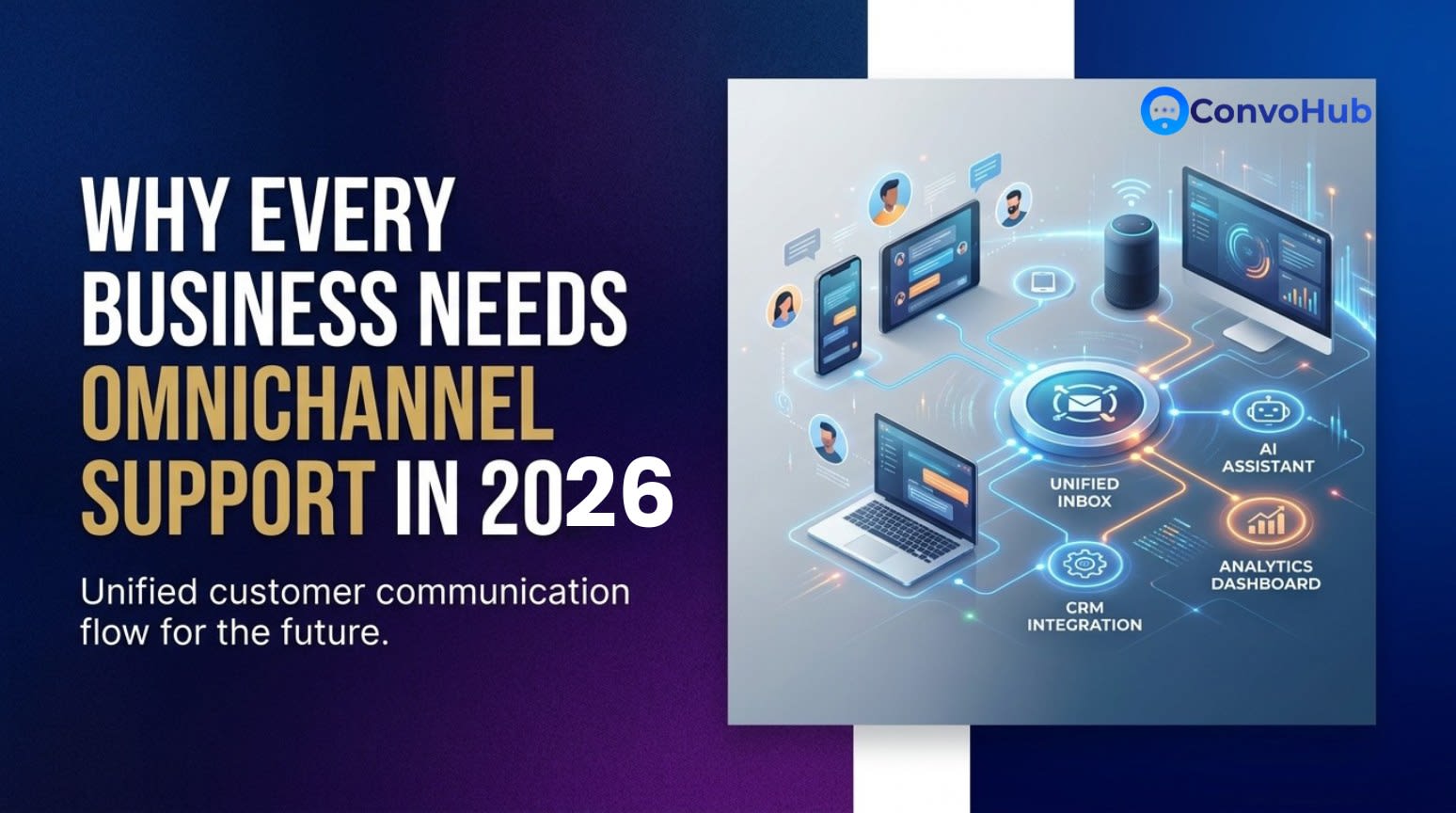
Why Every Business Needs an Omnichannel Support System in 2026
Customer expectations have evolved. Discover why omnichannel support is no longer optional and how to implement it effectively for your business.