
How to Convert More Leads Using Automated Follow-Ups
Vikram Singh
VP of Customer Success
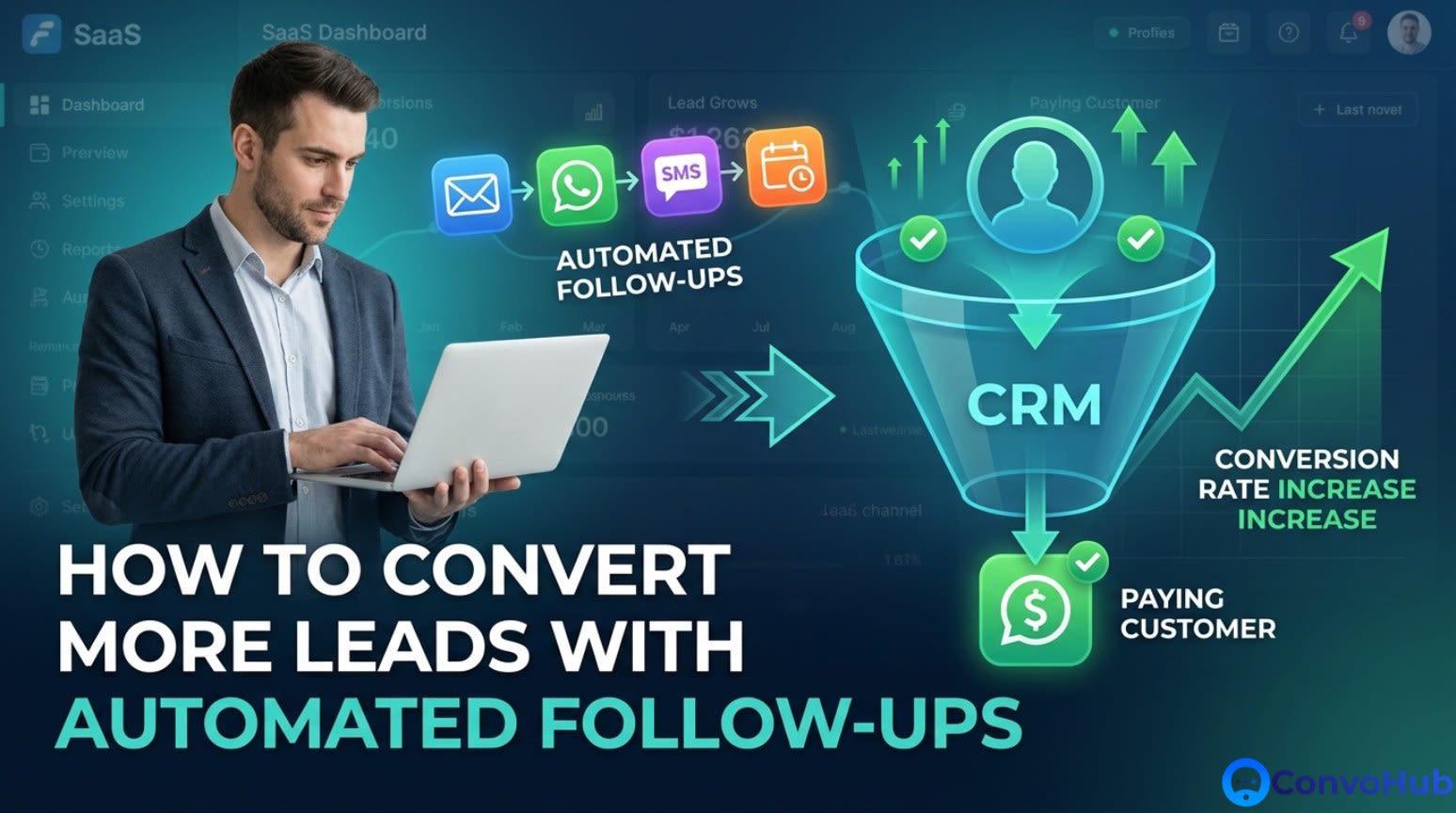
How to Convert More Leads Using Automated Follow-Ups
Here's a sobering stat: 80% of sales require at least 5 follow-up contacts after the initial meeting. Yet, 44% of salespeople give up after just one follow-up.
The math is simple—if you're not following up consistently, you're leaving money on the table. But here's the problem: manual follow-ups are time-consuming, easy to forget, and difficult to scale.
Enter automated follow-ups: the secret weapon of high-converting businesses.
Why Follow-Ups Matter (And Why We Avoid Them)
The Psychology of Buying
People rarely buy on the first interaction. The customer journey looks more like this:
1. Awareness: "This product exists"
2. Interest: "This might solve my problem"
3. Consideration: "Let me compare options"
4. Intent: "I'm leaning toward buying"
5. Purchase: "Okay, I'm ready"
Most leads are stuck somewhere between steps 2-4. They need nurturing, education, and gentle reminders. Without follow-ups, they simply forget about you or go with a competitor who stayed top-of-mind.
Why Manual Follow-Ups Fail
They're forgotten
- You're busy. Leads slip through the cracks.
- No system means relying on memory.
- Urgent tasks always overshadow important follow-ups.
They're inconsistent
- Good week = lots of follow-ups
- Busy week = zero follow-ups
- Your conversion rate becomes unpredictable.
They don't scale
- 10 leads = manageable
- 100 leads = overwhelming
- 1,000 leads = impossible
They lack data
- No idea what's working
- Can't optimize timing or messaging
- Difficult to measure ROI
The Power of Automation
Automation doesn't replace the personal touch—it enables it at scale.
What Automated Follow-Ups Can Do
✅ Never miss a lead - Every lead enters a nurture sequence automatically
✅ Perfect timing - Send messages at optimal times based on data
✅ Personalization at scale - Use lead data to customize messages
✅ Consistent experience - Every lead gets the same quality of follow-up
✅ Free up your time - Focus on closing, not chasing
✅ Continuous optimization - Test and improve based on performance data
The Results Speak for Themselves
- Increase conversion rates by 50%+ with consistent follow-up
- Reduce sales cycle length by 30% with timely touchpoints
- Improve lead response rates by 300% with instant initial contact
- Boost customer lifetime value by 40% through better onboarding
Building Your Automated Follow-Up System
Let's build a practical, effective automated follow-up workflow you can implement this week.
Step 1: Map Your Follow-Up Sequence
Start by planning your touchpoints. Here's a proven 7-touch sequence:
Touch 1: Immediate (0 minutes)
- Channel: Email + WhatsApp
- Message: "Thanks for your interest! Here's what happens next..."
- Goal: Set expectations and confirm receipt
Touch 2: Quick Value (1 hour)
- Channel: WhatsApp
- Message: Share a helpful resource relevant to their interest
- Goal: Provide value, not just sell
Touch 3: Educational (1 day)
- Channel: Email
- Message: Case study or success story
- Goal: Build credibility and demonstrate results
Touch 4: Personal Check-in (3 days)
- Channel: WhatsApp
- Message: "Any questions about [specific topic]?"
- Goal: Open dialogue and identify objections
Touch 5: Urgency/Offer (5 days)
- Channel: Email
- Message: Limited-time offer or bonus
- Goal: Create reason to act now
Touch 6: Social Proof (7 days)
- Channel: WhatsApp
- Message: Customer testimonials and reviews
- Goal: Overcome trust barriers
Touch 7: Last Chance (10 days)
- Channel: Email + WhatsApp
- Message: "Should I close your file?"
- Goal: Final nudge or graceful exit
Step 2: Segment Your Leads
Not all leads are created equal. Tailor your follow-up based on:
Lead source
- Website form → Educational sequence
- Social media → Social-first approach
- Referral → Relationship-focused
- Event/webinar → Event-specific content
Engagement level
- Hot (active engagement) → Aggressive follow-up, sales-focused
- Warm (some engagement) → Educational nurture sequence
- Cold (no engagement) → Re-engagement campaign
Product interest
- Product A → Case studies for Product A
- Product B → Different messaging and offers
- Undecided → General education and comparison content
Demographics/firmographics
- Small business → Cost-effectiveness, ease of use
- Enterprise → ROI, security, scalability
- Industry-specific → Relevant use cases
Step 3: Choose Your Channels Wisely
Different channels serve different purposes.
[WhatsApp](/whatsapp-support-logistics-uae) 🏆
- Best for: Conversational, personal follow-ups
- Open rate: 98%
- Response rate: 40-60%
- When to use: Quick check-ins, questions, time-sensitive offers
- Best for: Detailed information, resources, formal communication
- Open rate: 20-25%
- Response rate: 5-10%
- When to use: Case studies, guides, longer-form content
SMS
- Best for: Time-sensitive alerts and reminders
- Open rate: 98%
- Response rate: 45%
- When to use: Appointment reminders, limited-time offers
Phone
- Best for: High-value leads, complex products
- Contact rate: 30-40%
- Conversion rate: Highest
- When to use: Qualified leads ready to buy
Pro tip: Use multiple channels in combination. Start with WhatsApp for immediate touch, follow with email for details, use SMS for reminders.
Step 4: Craft Compelling Messages
Your automated messages should feel personal, not robotic.
Subject Line / Opening Formula:
❌ Bad: "Follow-up"
✅ Good: "Quick question about [specific interest]"
❌ Bad: "Checking in"
✅ Good: "Sarah, this made me think of you"
Body Copy Principles:
1. Lead with value, not features
- ❌ "Our platform has 50+ integrations"
- ✅ "Save 5 hours/week by automating your workflow"
2. Use their name and specific details
- ❌ "Hi there, following up on your inquiry"
- ✅ "Hi Jennifer, saw you were interested in automating customer support for your e-commerce store"
3. One clear call-to-action
- ❌ Multiple links and requests
- ✅ Single, specific next step ("Reply with your best time for a 15-min call")
4. Keep it conversational
- ❌ Corporate jargon and formal language
- ✅ Write like you're texting a friend
5. Include a clear out
- "Not interested? No problem—just reply STOP and I won't bother you again."
Step 5: Set Up the Automation
Option 1: Email Automation (Good)
- Tools: Mailchimp, ConvertKit, ActiveCampaign
- Pros: Easy to set up, affordable, familiar
- Cons: Lower open rates, feels more "marketing-y"
Option 2: [WhatsApp](/whatsapp-crm-financial-services-brazil) Automation (Better)
- Tools: ConvoHub, Twilio, other WhatsApp Business API platforms
- Pros: Highest engagement, personal feel, conversational
- Cons: Requires WhatsApp Business API setup
Option 3: Multi-Channel Automation (Best)
- Tools: ConvoHub (WhatsApp + Email), HubSpot, Salesforce
- Pros: Reach leads where they're most responsive
- Cons: More complex setup, higher cost
Quick Setup Guide with ConvoHub:
1. Create your message templates
- Write your 7 follow-up messages
- Personalize with customer data fields
- Get WhatsApp message templates approved
2. Set up trigger events
- New lead form submission
- Demo request
- Free trial signup
- Shopping cart abandonment
3. Configure timing and logic
- Set delays between messages
- Add conditional logic (if X, then Y)
- Set up A/B tests
4. Define exit conditions
- Lead converts → Move to customer onboarding sequence
- Lead responds → Alert sales team for manual follow-up
- Lead opts out → Remove from sequence
Step 6: Optimize Based on Data
Automation gives you data. Use it.
Key Metrics to Track:
📊 Delivery rate - Are messages reaching leads?
📊 Open rate - Are they reading your messages?
📊 Click-through rate - Are they engaging with links?
📊 Response rate - Are they replying?
📊 Conversion rate - Are they becoming customers?
📊 Time to conversion - How long does the sequence take?
📊 Drop-off points - Where do leads disengage?
Optimization Tactics:
✅ A/B test subject lines - Small changes, big impact
✅ Test send times - Morning vs afternoon vs evening
✅ Vary content types - Video vs text vs images
✅ Adjust sequence length - Some audiences need more/fewer touches
✅ Experiment with channels - Try WhatsApp vs Email for different segments
Real-World Follow-Up Workflows
Workflow 1: E-commerce Cart Abandonment
Trigger: Customer adds item to cart but doesn't complete purchase
- 10 minutes: WhatsApp - "Forgot something? Your cart is waiting"
- 2 hours: Email with product images and reviews
- 24 hours: WhatsApp with 10% discount code
- 3 days: Email with similar customer stories
- 7 days: Final reminder with extended discount
Result: 20-30% cart recovery rate
Workflow 2: Service Business Lead Nurture
Trigger: Lead downloads free guide or requests consultation
- Immediately: Email with promised resource
- 1 hour: WhatsApp introduction and availability check
- 2 days: Email case study
- 4 days: WhatsApp with common questions answered
- 6 days: Video testimonial via email
- 9 days: Booking link with limited slots
Result: 15-25% consultation booking rate
Workflow 3: SaaS Free Trial Follow-Up
Trigger: User signs up for free trial
- Day 0: Welcome email with getting started guide
- Day 1: WhatsApp check-in - "Need help setting up?"
- Day 3: Feature highlight email
- Day 5: WhatsApp success story
- Day 7: Upgrade offer (trial ending soon)
- Day 10: Personal outreach from sales team
Result: 25-40% trial-to-paid conversion
Common Follow-Up Mistakes to Avoid
Mistake #1: Too Salesy, Too Soon
Lead nurturing is about building relationships. Don't push for the sale in every message.
Better approach: 80% value, 20% selling
Mistake #2: Identical Messages to Everyone
Segmentation matters. A small business owner and enterprise executive need different messaging.
Better approach: Create 3-5 sequences for different audience segments
Mistake #3: Ignoring Responses
Automation is great, but human touch is irreplaceable. When leads respond, have a system to alert your team.
Better approach: Set up notifications and SLAs for response handling
Mistake #4: No Clear Next Step
Every message should have one clear, easy action.
Better approach: Single CTA, specific ask, low friction
Mistake #5: Set-and-Forget
Your first sequence won't be perfect. Continuous testing and optimization is essential.
Better approach: Monthly performance reviews and quarterly sequence overhauls
Advanced Follow-Up Strategies
Once you've mastered the basics, level up with these tactics:
Behavioral Triggers
Go beyond time-based sequences. Trigger messages based on actions:
- Visited pricing page 3x → "Questions about pricing?"
- Watched demo video → "Ready to see it in action?"
- Downloaded competitor comparison → "Switching from [Competitor]?"
Re-engagement Campaigns
Bring cold leads back to life:
- "We've launched new features since you last checked in"
- "Your industry is evolving—here's how [product] helps"
- "Should I remove you from my list?"
Referral Follow-Ups
Turn customers into advocates:
- Post-purchase: "Love [product]? Know someone else who would?"
- After positive review: "Would you share your experience?"
- NPS promoters: "Help us grow—refer a friend, get [reward]"
The ConvoHub Advantage for Follow-Ups
ConvoHub makes automated follow-ups ridiculously easy:
✅ WhatsApp-First Automation - Leverage the highest engagement channel
✅ Visual Flow Builder - Create sequences with drag-and-drop
✅ Smart Personalization - Dynamic fields and conditional logic
✅ Multi-Channel Sync - Coordinate WhatsApp, email, and SMS
✅ Real-Time Analytics - Track performance and optimize
✅ Seamless Handoffs - Alert sales team when leads engage
Your Action Plan
This Week:
- [ ] Map out your ideal 7-touch follow-up sequence
- [ ] Write draft messages for each touchpoint
- [ ] Choose your automation platform
This Month:
- [ ] Set up your first automated sequence
- [ ] Test with a small segment of leads
- [ ] Analyze results and iterate
This Quarter:
- [ ] Build sequences for different lead segments
- [ ] Implement behavioral triggers
- [ ] Optimize based on performance data
Conclusion
Follow-ups aren't optional—they're essential. But doing them manually is a recipe for inconsistency and missed opportunities.
Automated follow-ups give you:
- Consistency - Every lead gets nurtured
- Scalability - Handle 10 or 10,000 leads with ease
- Efficiency - Free up time for high-value activities
- Results - More conversions, shorter sales cycles, higher revenue
The businesses winning in 2025 aren't necessarily the ones with the best products—they're the ones with the best follow-up systems.
What's stopping you from building yours?
*Ready to automate your follow-ups and never miss a lead again? Discover how ConvoHub's WhatsApp automation can transform your conversion rates.*
Related Tools
- Free UTM Builder — tag your follow-up links to see exactly which message in your sequence drives conversions
- Free WhatsApp Link Generator — create deep links that open a WhatsApp chat with a pre-filled message for your follow-up sequences
- WhatsApp Business API Pricing Calculator — estimate the cost of running broadcast follow-up campaigns at scale
Frequently Asked Questions
Related Articles
Best Practices for Bulk Messaging Compliance
Learn how to ensure your bulk messaging campaigns comply with regulations while maintaining effective customer communication.
ROI of Automated Customer Support
Analyze the return on investment for implementing AI-powered automated customer support systems across communication channels.